Annex E – Connection Point Registration Extension
The intent of the Connection Point registration extension is to provide the capability for SEP2 servers to offer a consistent mechanism to provide additional information about the existence and location of a newly registered device on the network.
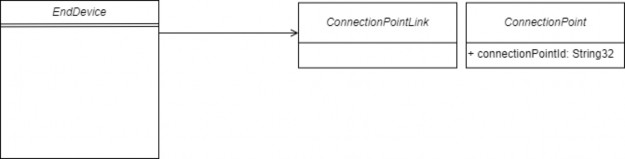
ConnectionPoint package
Contains identification information related to the network location at which the EndDevice is installed.
The ConnectionPoint identifier. By default, the National Metering Identifier (NMI) is used to identify the network location of the device in this attribute.
SHALL contain a Link to an instance of ConnectionPoint.
Web-application description language
Implementation
The implementation of this extension includes a change to the CSIP operating procedures and an additional endpoint that is exposed by the server.
The server may validate that the supplied information matches installation details provided in separate processes (for example, through network connection applications). Where the server determines that the supplied ConnectionPoint id is invalid, the server shall return a HTTP 400 response with
reasonCode = 1 (invalid request value), for example:
<Error xmlns="urn:ieee:std:2030.5:ns">
<reasonCode>1</reasonCode>
</Error>
Where this extension is used, the server shall support updates to ConnectionPoint identifier through a PUT request. This may be used, for instance, to correct an incorrectly entered identifier.
Step | Description |
1-8 | Follow the same procedure as Table C.1 of CSIP, steps 1-8 |
9 | Client GETs its EndDeviceList from Server as configured (or as returned in DNS-SD Discovery). Client sends the following request: GET /edev HTTP/1.1 Host: {hostname} Accept: application/sep+xml |
10 | Server responds with the EndDeviceList resource. The response contains a list of EndDevices registered by this client, with the first entry being the aggregator EndDevice. Server sends the following response: HTTP/1.1 200 OK Content-Type: application/sep+xml Content-Length: {contentLength} <EndDevicelist href= "/sep2/edev" subscribable="1" all="3" results="3" xmlns="urn:ieee:std:2030.5:ns" xmlns:csipaus=”https://csipaus.org/ns” > <EndDevice href "/sep2/edev/1000"> <LFDI> 9dfdd56f6128cdc894ale42c698cab197184aBe9</1 FDI> <LogEventListLink href="/sep2/edev/ 1000/1og" all="0"/> <sFDI>424105305561</sFDI> <changedTime>1514837000 </changedTime> <enabled>1</enabled> <RegistrationLink href "/sep2/edev/1008/rg"/> <SubscriptionListLink href="/sep2/edev/1000/ sub" all="0"/> </EndDevice> <EndDevice href "/sep2/edev/1"> <csipaus:ConnectionPointLink href=”/edev/1/cp”/> <DERListLink href="/sep2/edev/1/der" all="0"/> <LFDI>12a4a4b406ad102e7421019135ffa2805235a21c</1FDI» <LogEventlistlink href-"/sep2/edev/ 1/log" all- "9"/> <sFDI>050044792964</sFDI> <changedTime>1514836800 </changedTime> <enabled>1</enabled> <FunctionSetAssignmentsListLink href="/sep2/edev/1/fs a" all="2"/> RegistrationLink href-"/sep2/edev/1/re"/> </EndDevice> <EndDevice href="/sep2/edev/2"> <csipaus:ConnectionPointLink href=”/edev/2/cp”/> <DERListLink href="/sep2/edev/2/der" all="e"/> |
<LFDI>5509d69f8b353595206ad71b47e27906318ea367</LFDI> <LogEventListlink href="/sep2/edev/2/log" all="0"/> <sFDI> 228273300409</sFDI> <changedTime>1514836800 </changedTime> <enabled>1</enabled> <FunctionsetAss ignmentsListlink href="/sep2/edev/2/fsa" all="2/> <RegistrationLink href="/sep2/edev/2/rg"/> </EndDevice> </EndDevicelist> | |
11 | The client then POSTs to Device Registration endpoint information on the device to be registered, for which the aggregator will be communicating on behalf of: POST /edev/ HTTP/1.1 Host: {hostname} Content-Type: application/sep+xml Content-Length: {contentLength} <EndDevice xmlns="urn:ieee:std:2030.5:ns"> <sFDI>789654321005</sFDI> <changedTime>1379905200</changedTime> </EndDevice> |
12 | Server indicates the EndDevice record was created with the following: If a new EndDevice entry is created, the server would respond with the following where Location indicates the path to the newly created EndDevice resource: HTTP/1.1 201 Created Location: /edev/4 A subsequent call to the GET /edev/ endpoint will return a list containing the newly created resource. |
Optional Extension |